mirror of
https://github.com/jackyzha0/quartz.git
synced 2025-12-27 23:04:05 -06:00

317 lines
11 KiB
Markdown
317 lines
11 KiB
Markdown
## Introduction
|
||
|
||
Godoc [examples](https://go.dev/pkg/testing/#hdr-Examples) are snippets of Go code that are displayed as package documentation and that are verified by running them as tests. They can also be run by a user visiting the godoc web page for the package and clicking the associated “Run” button.
|
||
|
||
Having executable documentation for a package guarantees that the information will not go out of date as the API changes.
|
||
|
||
The standard library includes many such examples (see the [`strings` package](https://go.dev/pkg/strings/#Contains), for instance).
|
||
|
||
This article explains how to write your own example functions.
|
||
|
||
## Examples are tests
|
||
|
||
Examples are compiled (and optionally executed) as part of a package’s test suite.
|
||
|
||
As with typical tests, examples are functions that reside in a package’s `_test.go` files. Unlike normal test functions, though, example functions take no arguments and begin with the word `Example` instead of `Test`.
|
||
|
||
The [`reverse` package](https://pkg.go.dev/golang.org/x/example/hello/reverse/) is part of the [Go example repository](https://cs.opensource.google/go/x/example). Here’s an example that demonstrates its `String` function:
|
||
|
||
```
|
||
package reverse_test
|
||
|
||
import (
|
||
"fmt"
|
||
|
||
"golang.org/x/example/hello/reverse"
|
||
)
|
||
|
||
func ExampleString() {
|
||
fmt.Println(reverse.String("hello"))
|
||
// Output: olleh
|
||
}
|
||
```
|
||
|
||
This code might live in `example_test.go` in the `reverse` directory.
|
||
|
||
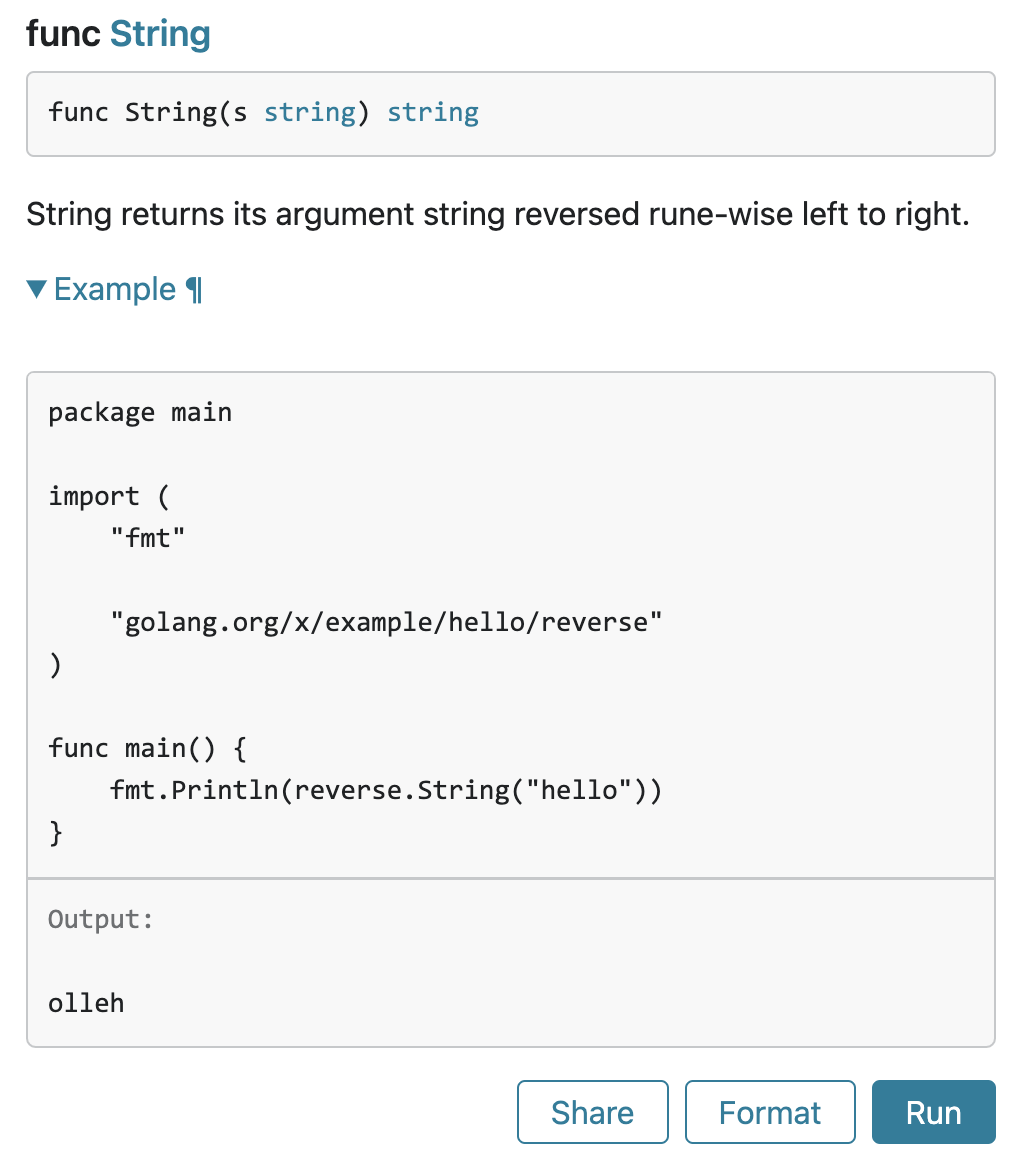
The Go package documentation server _pkg.go.dev_ presents this example alongside the [`String` function’s documentation](https://pkg.go.dev/golang.org/x/example/hello/reverse/#String):
|
||
|
||
|
||
|
||
Running the package’s test suite, we can see the example function is executed with no further arrangement from us:
|
||
|
||
```
|
||
$ go test -v
|
||
=== RUN TestString
|
||
--- PASS: TestString (0.00s)
|
||
=== RUN ExampleString
|
||
--- PASS: ExampleString (0.00s)
|
||
PASS
|
||
ok golang.org/x/example/hello/reverse 0.209s
|
||
```
|
||
|
||
## Output comments
|
||
|
||
What does it mean that the `ExampleString` function “passes”?
|
||
|
||
As it executes the example, the testing framework captures data written to standard output and then compares the output against the example’s “Output:” comment. The test passes if the test’s output matches its output comment.
|
||
|
||
To see a failing example we can change the output comment text to something obviously incorrect
|
||
|
||
```
|
||
func ExampleString() {
|
||
fmt.Println(reverse.String("hello"))
|
||
// Output: golly
|
||
}
|
||
```
|
||
|
||
and run the tests again:
|
||
|
||
```
|
||
$ go test
|
||
--- FAIL: ExampleString (0.00s)
|
||
got:
|
||
olleh
|
||
want:
|
||
golly
|
||
FAIL
|
||
```
|
||
|
||
If we remove the output comment entirely
|
||
|
||
```
|
||
func ExampleString() {
|
||
fmt.Println(reverse.String("hello"))
|
||
}
|
||
```
|
||
|
||
then the example function is compiled but not executed:
|
||
|
||
```
|
||
$ go test -v
|
||
=== RUN TestString
|
||
--- PASS: TestString (0.00s)
|
||
PASSIntroduction
|
||
Godoc examples are snippets of Go code that are displayed as package documentation and that are verified by running them as tests. They can also be run by a user visiting the godoc web page for the package and clicking the associated “Run” button.
|
||
|
||
Having executable documentation for a package guarantees that the information will not go out of date as the API changes.
|
||
|
||
The standard library includes many such examples (see the strings package, for instance).
|
||
|
||
This article explains how to write your own example functions.
|
||
|
||
Examples are tests
|
||
Examples are compiled (and optionally executed) as part of a package’s test suite.
|
||
|
||
As with typical tests, examples are functions that reside in a package’s _test.go files. Unlike normal test functions, though, example functions take no arguments and begin with the word Example instead of Test.
|
||
|
||
The reverse package is part of the Go example repository. Here’s an example that demonstrates its String function:
|
||
|
||
package reverse_test
|
||
|
||
import (
|
||
"fmt"
|
||
|
||
"golang.org/x/example/hello/reverse"
|
||
)
|
||
|
||
func ExampleString() {
|
||
fmt.Println(reverse.String("hello"))
|
||
// Output: olleh
|
||
}
|
||
This code might live in example_test.go in the reverse directory.
|
||
|
||
The Go package documentation server pkg.go.dev presents this example alongside the String function’s documentation:
|
||
|
||
|
||
Running the package’s test suite, we can see the example function is executed with no further arrangement from us:
|
||
|
||
$ go test -v
|
||
=== RUN TestString
|
||
--- PASS: TestString (0.00s)
|
||
=== RUN ExampleString
|
||
--- PASS: ExampleString (0.00s)
|
||
PASS
|
||
ok golang.org/x/example/hello/reverse 0.209s
|
||
Output comments
|
||
What does it mean that the ExampleString function “passes”?
|
||
|
||
As it executes the example, the testing framework captures data written to standard output and then compares the output against the example’s “Output:” comment. The test passes if the test’s output matches its output comment.
|
||
|
||
To see a failing example we can change the output comment text to something obviously incorrect
|
||
|
||
func ExampleString() {
|
||
fmt.Println(reverse.String("hello"))
|
||
// Output: golly
|
||
}
|
||
and run the tests again:
|
||
|
||
$ go test
|
||
--- FAIL: ExampleString (0.00s)
|
||
got:
|
||
olleh
|
||
want:
|
||
golly
|
||
FAIL
|
||
If we remove the output comment entirely
|
||
|
||
func ExampleString() {
|
||
fmt.Println(reverse.String("hello"))
|
||
}
|
||
then the example function is compiled but not executed:
|
||
|
||
$ go test -v
|
||
=== RUN TestString
|
||
--- PASS: TestString (0.00s)
|
||
PASS
|
||
ok golang.org/x/example/hello/reverse 0.110s
|
||
Examples without output comments are useful for demonstrating code that cannot run as unit tests, such as that which accesses the network, while guaranteeing the example at least compiles.
|
||
|
||
Example function names
|
||
Godoc uses a naming convention to associate an example function with a package-level identifier.
|
||
|
||
func ExampleFoo() // documents the Foo function or type
|
||
func ExampleBar_Qux() // documents the Qux method of type Bar
|
||
func Example() // documents the package as a whole
|
||
Following this convention, godoc displays the ExampleString example alongside the documentation for the String function.
|
||
|
||
Multiple examples can be provided for a given identifier by using a suffix beginning with an underscore followed by a lowercase letter. Each of these examples documents the String function:
|
||
|
||
func ExampleString()
|
||
func ExampleString_second()
|
||
func ExampleString_third()
|
||
Larger examples
|
||
Sometimes we need more than just a function to write a good example.
|
||
|
||
For instance, to demonstrate the sort package we should show an implementation of sort.Interface. Since methods cannot be declared inside a function body, the example must include some context in addition to the example function.
|
||
|
||
To achieve this we can use a “whole file example.” A whole file example is a file that ends in _test.go and contains exactly one example function, no test or benchmark functions, and at least one other package-level declaration. When displaying such examples godoc will show the entire file.
|
||
|
||
Here is a whole file example from the sort package:
|
||
|
||
package sort_test
|
||
|
||
import (
|
||
"fmt"
|
||
"sort"
|
||
)
|
||
|
||
type Person struct {
|
||
Name string
|
||
Age int
|
||
}
|
||
|
||
func (p Person) String() string {
|
||
return fmt.Sprintf("%s: %d", p.Name, p.Age)
|
||
}
|
||
|
||
// ByAge implements sort.Interface for []Person based on
|
||
// the Age field.
|
||
type ByAge []Person
|
||
|
||
func (a ByAge) Len() int { return len(a) }
|
||
func (a ByAge) Swap(i, j int) { a[i], a[j] = a[j], a[i] }
|
||
func (a ByAge) Less(i, j int) bool { return a[i].Age < a[j].Age }
|
||
|
||
func Example() {
|
||
people := []Person{
|
||
{"Bob", 31},
|
||
{"John", 42},
|
||
{"Michael", 17},
|
||
{"Jenny", 26},
|
||
}
|
||
|
||
fmt.Println(people)
|
||
sort.Sort(ByAge(people))
|
||
fmt.Println(people)
|
||
|
||
// Output:
|
||
// [Bob: 31 John: 42 Michael: 17 Jenny: 26]
|
||
// [Michael: 17 Jenny: 26 Bob: 31 John: 42]
|
||
}
|
||
A package can contain multiple whole file examples; one example per file. Take a look at the sort package’s source code to see this in practice.
|
||
|
||
Conclusion
|
||
Godoc examples are a great way to write and maintain code as documentation. They also present editable, working, runnable examples your users can build on. Use them!
|
||
ok golang.org/x/example/hello/reverse 0.110s
|
||
```
|
||
|
||
Examples without output comments are useful for demonstrating code that cannot run as unit tests, such as that which accesses the network, while guaranteeing the example at least compiles.
|
||
|
||
## Example function names
|
||
|
||
Godoc uses a naming convention to associate an example function with a package-level identifier.
|
||
|
||
```
|
||
func ExampleFoo() // documents the Foo function or type
|
||
func ExampleBar_Qux() // documents the Qux method of type Bar
|
||
func Example() // documents the package as a whole
|
||
```
|
||
|
||
Following this convention, godoc displays the `ExampleString` example alongside the documentation for the `String` function.
|
||
|
||
Multiple examples can be provided for a given identifier by using a suffix beginning with an underscore followed by a lowercase letter. Each of these examples documents the `String` function:
|
||
|
||
```
|
||
func ExampleString()
|
||
func ExampleString_second()
|
||
func ExampleString_third()
|
||
```
|
||
|
||
## Larger examples
|
||
|
||
Sometimes we need more than just a function to write a good example.
|
||
|
||
For instance, to demonstrate the [`sort` package](https://go.dev/pkg/sort/) we should show an implementation of `sort.Interface`. Since methods cannot be declared inside a function body, the example must include some context in addition to the example function.
|
||
|
||
To achieve this we can use a “whole file example.” A whole file example is a file that ends in `_test.go` and contains exactly one example function, no test or benchmark functions, and at least one other package-level declaration. When displaying such examples godoc will show the entire file.
|
||
|
||
Here is a whole file example from the `sort` package:
|
||
|
||
```
|
||
package sort_test
|
||
|
||
import (
|
||
"fmt"
|
||
"sort"
|
||
)
|
||
|
||
type Person struct {
|
||
Name string
|
||
Age int
|
||
}
|
||
|
||
func (p Person) String() string {
|
||
return fmt.Sprintf("%s: %d", p.Name, p.Age)
|
||
}
|
||
|
||
// ByAge implements sort.Interface for []Person based on
|
||
// the Age field.
|
||
type ByAge []Person
|
||
|
||
func (a ByAge) Len() int { return len(a) }
|
||
func (a ByAge) Swap(i, j int) { a[i], a[j] = a[j], a[i] }
|
||
func (a ByAge) Less(i, j int) bool { return a[i].Age < a[j].Age }
|
||
|
||
func Example() {
|
||
people := []Person{
|
||
{"Bob", 31},
|
||
{"John", 42},
|
||
{"Michael", 17},
|
||
{"Jenny", 26},
|
||
}
|
||
|
||
fmt.Println(people)
|
||
sort.Sort(ByAge(people))
|
||
fmt.Println(people)
|
||
|
||
// Output:
|
||
// [Bob: 31 John: 42 Michael: 17 Jenny: 26]
|
||
// [Michael: 17 Jenny: 26 Bob: 31 John: 42]
|
||
}
|
||
```
|
||
|
||
A package can contain multiple whole file examples; one example per file. Take a look at the [`sort` package’s source code](https://go.dev/src/sort/) to see this in practice.
|
||
|
||
## Conclusion
|
||
|
||
Godoc examples are a great way to write and maintain code as documentation. They also present editable, working, runnable examples your users can build on. Use them! |